Session Intelligence Feed
A post-session AI dashboard that turns every study session into a structured card, giving students and parents a reason to come back. Built with React (Lovable), Claude API (Supabase edge functions), and real mock data grounded in Nerdy's Q1 2026 earnings context.
What this project proves.
Product thinking — Identified a retention gap in Nerdy's Q1 2026 earnings and built a working feature response grounded in competitive research across five edtech platforms.
AI-fluent execution — Designed, specced, and shipped a working prototype with live Claude API integration in under 48 hours using Claude, Lovable, Framer, and Supabase.
Synthesize discovery — Synthesized Nerdy's investor call, public website, and customer reviews to surface the retention gap before writing a single requirement.
Why is this page relevant to you? — If you need an experienced PM who can move from business problem to working product, orchestrate AI to execute, and is proactive enough to build this to get your attention — this is what that looks like.
The Problem
Nerdy's Q1 2026 earnings named member retention as the highest-growth lever in the business. The Varsity Tutors platform generates rich learning data during every session — concepts covered, knowledge gaps, AI interactions, and tutor notes. That data never surfaces in the learner's dashboard after the session ends. Members have no daily reason to open the app, no visible evidence of value between billing cycles, and no connection between what happened in their last session and what to do before the next one. Public reviews confirm it: unused sessions, invisible progress, and billing surprises are the top cancellation drivers.
"At today's customer acquisition cost, every additional month of average tenure flows almost entirely through to contribution profit." — Chuck Cohn, Q1 2026 Earnings Call
The Insight
Platforms like IXL and Khan Academy offer parent reporting and skill tracking, but none of them have access to live tutor session transcripts as the data source. That is a structural advantage Nerdy already holds. The gap is not in data collection. It is in surfacing the data that already exists.
The Solution
A post-session layer that auto-generates on the Nerdy dashboard after each Varsity Tutors session. It surfaces what the tutor actually taught, which concepts need follow-up, and one specific action the student should take before the next session. No new data collection required. It runs on transcripts, AI Practice activity, and session notes Nerdy already captures.
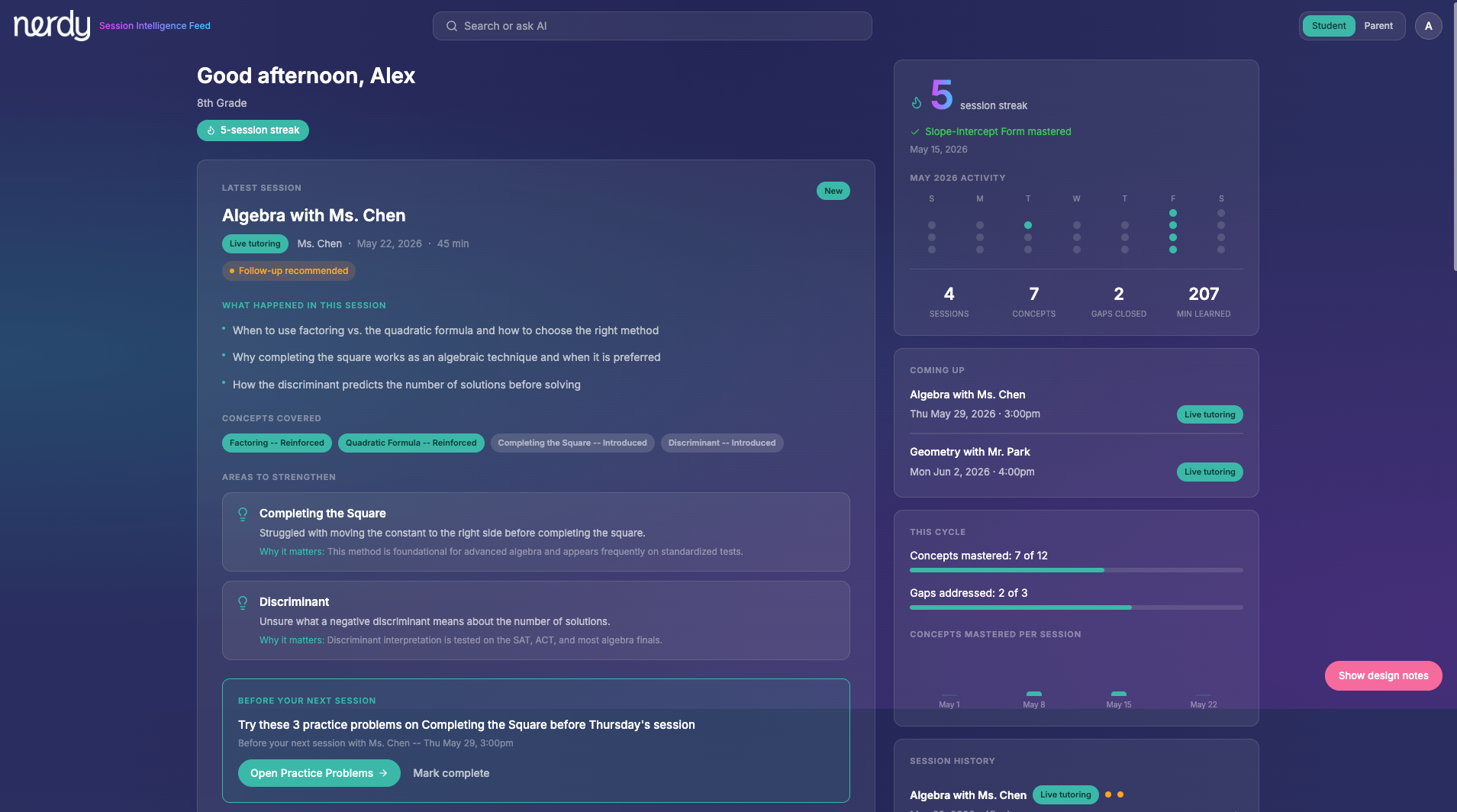
UI prototype. Not connected to live data. AI features are functional via Supabase edge functions connected to the Claude API.
Two-page PRD covering problem, opportunity, solution, business requirements, and expected outcomes.
Twelve feature tickets covering every screen and interaction, organized by priority and scope.
Working prototype powered by Supabase edge functions and live Claude API calls. Try it end-to-end.
Build Process
→ Researched Nerdy from the outside in.
Started with the Q1 2026 earnings call, Nerdy's website, and public customer reviews on Trustpilot and Reddit to map the actual business problem before touching a design tool.
→ Downloaded and used the Nerdy app.
Hands-on product audit confirmed the integration gap between the Nerdy desktop app and the Varsity Tutors session platform. The gap is real, visible, and closeable without new infrastructure.
→ Synthesized research into a product brief.
Structured findings into a two-page business PRD before building anything. Problem, opportunity, solution, business requirements, expected outcomes. Download the PRD →
→ Set up Claude as a project-level thinking partner.
Created a dedicated Claude project with hardcoded context about the goal, constraints, and behavioral rules. Claude served as research partner, PRD and Jira/Notion development tickets co-author, prompt engineer, and QA reviewer throughout the build.
→ Turned business requirements into development tickets.
Wrote 12 feature tickets covering every screen and interaction, organized by priority.
View the tickets →→ Connected Claude to Lovable via MCP and shipped a UI prototype.
Used Claude-to-Lovable MCP integration to generate, iterate, and refine the full prototype with live AI features powered by Supabase edge functions connected to the Claude API. View the prototype →